

Report
Equal Footing - The Inland West and the Southeast
The Southeast became a consensus allocation because a decade of research documented its demand drivers: in-migration, job growth, affordability relative to the coasts. Capital followed. The Inland West has shown the same strength for years, but no comparable research exists, largely because the region isn't captured in anyone's data. State lines split it up in ways that ignore how it actually functions, so its growth gets buried inside coastal-state averages describing a different economy. Having operated here for 18 years, we've watched the Inland West check every box that made the Southeast investable: sustained in-migration, a young population, income convergence, employment growth outpacing the nation, just without the data to prove it. This paper closes that gap, using the same metrics, the same 21-year window, and the same federal sources, mapped onto the geography the region actually occupies.
HEAT MAP
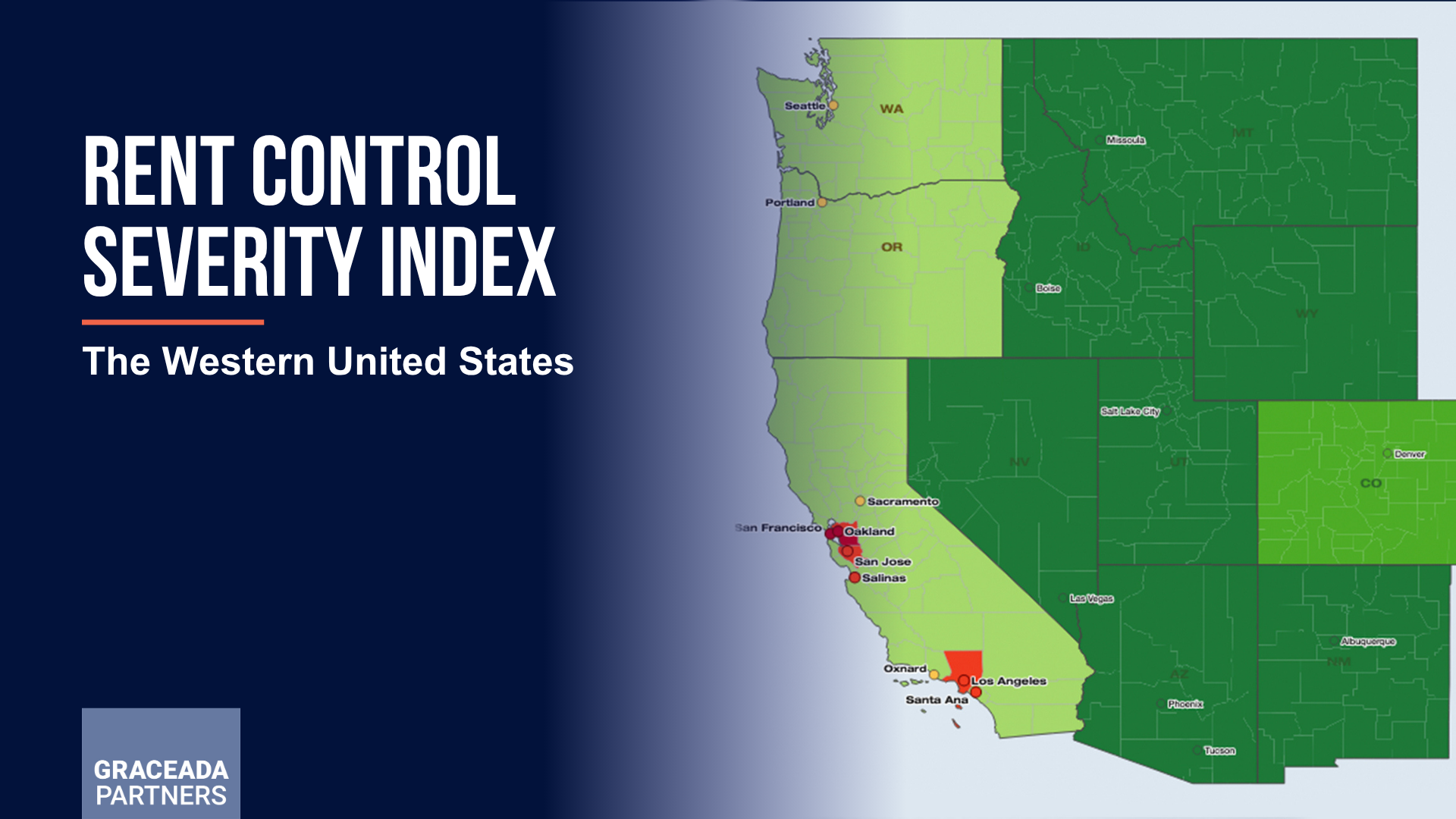
Rent Control Severity Index – Western United States
A jurisdiction-by-jurisdiction heat map of rent regulation across the Western United States, scored on a weighted composite that measures severity – cap strength, vacancy treatment, just-cause standards, new-construction exemptions, and whether a local enforcement board exists – rather than the mere presence of a law. This research was done to provide context on where highly restrictive rent control regulations exist in the Western U.S. – confined almost entirely to coastal local ordinances, not statewide frameworks.

Report
Why We Invest in Multi-Tenant Industrial & Workforce Housing
During our 18-year history as a firm, we’ve had the opportunity to invest and create value across all four of the main real estate asset classes: retail, office, multifamily, and industrial. Through the unique lens of our strategy and the markets in which we work, we have been able to weigh the relative merits and risk-adjusted return potential of each – as well as sub-assets within the four.
Through this experience, we have developed unique conviction around Multi-Tenant Industrial and Workforce Housing, sub- assets within industrial and multifamily, respectively. This whitepaper explores the unique attributes of these assets and why we have refined our strategy around them exclusively.

Report
Challenges to Investing In Secondary & Tertiary Markets
Over the past several years Graceada has provided research to help educate institutional investors on the misconceptions with investing in secondary and tertiary markets. But there are also very real challenges with investing in these markets. This whitepaper provides context on what those challenges or barriers are as well as how we have addressed those challenges with our investing.

Report
Understanding Misconceptions with Investing in Secondary & Tertiary Markets
Since the inception of the asset class, institutional investment in real estate has been characterized by an ever-expanding investment universe as more segments, sub-asset classes, and geographies become “investable” to institutional investors. This has been characterized by a repeated process of identifying new areas of investment, developing a process for accessing and investing, overcoming misconceptions, and building the infrastructure and expertise to successfully execute investments in the new areas.

Report
Economic Vibrancy in Graceada Secondary & Tertiary Markets
There is a common misconception in our industry that secondary and tertiary markets have less economic vibrancy and more volatility than primary markets, which runs counter to our 16 years of experience in these markets. In this analysis we compared primary markets in the Western US to secondary & tertiary markets over the last 20 year. The analysis underscores that secondary & tertiary markets in the Western US actually outperform primary markets in many key metrics (GDP growth, population growth, job growth, etc.) and with lower volatility.

Real Estate Fundamentals in Graceada Secondary & Tertiary Markets
This research piece analyzes real estate fundamentals in secondary and tertiary markets in the Western US versus primary markets over the past 20 years, inclusive of the periods of economic stress (GFC, pandemic, current rate hike environment). Looking at key real estate metrics in workforce housing and industrial (rent growth, net absorption, vacancy, and valuation), it concludes that these markets have performed better than or consistent with primary markets during this time period, including through market downturns.

Report
Overview of Private Real Estate Strategies
This presentation was a part of the UC Berkeley Haas Executive Education program for public pension trustees entitled “Modern Investment Portfolio & Practice.” It provides an overview of private real estate’s role in a diversified portfolio, the three private real estate strategies, and their respective attributes and characteristics.

Report
Historical Liquidity Analysis by Asset Size
Recent research contradicts the perception that investing in more institutional markets is more liquid and less volatile. Analysis demonstrates that liquidity in institutional markets, as viewed by asset size, is lower and more volatile than in less institutional asset sizes.

Two-Pager
5 Ways Value-Add Real Estate Investing Fits Into a Portfolio
This cut sheet provides a brief overview of how value-add real estate fits into a portfolio and operates very differently than traditional direct real estate investing or public REIT investing. It also touches on how Graceada Partners’ specific focus on secondary & tertiary markets adds value to a portfolio.

Report
The Emergent Value of Third
City Markets
As America’s population grows by roughly one million people each year, that doesn’t necessarily mean that city centers will grow at the same rate. The decade of the 2020s is expected to bring the U.S. population 5% higher, but not all cities and states will see the same growth. Not all cities are created equal.
5 Ways the Outpost Economy is Changing America Today
The year 2021 may very well be known as the year of the Great Resignation. We’ve heard that term everywhere. And for good reason. In September 2021 alone, 4.4 million people—or 3% of the workforce—quit their job. And that’s not even an anomaly; tens of millions of Americans left their job in 2021 in pursuit of greener pastures.
Rebirth
of a City
People are freer than ever to live and work where they please, which makes the answer to ‘Where do I want to be?’ one with an increasing number of possibilities for millions of professionals. The COVID-19 pandemic illuminated the fact that many jobs can be performed remotely—at least some of the time.

Rise of the
Outpost Economy
The Rise of the Outpost Economy: how young professionals searching for something new are shaping work – and the sweeping impact this trend is having on real estate, employers and cities.

California’s
Central
Valley
In today’s low interest-rate environment, investors are working overtime in their search for yield. In the real estate arena, property investors are searching beyond gateway and primary markets—where stiff competition has compressed cap rates to record lows for some property types—and exploring opportunities off the beaten track in overlooked secondary and tertiary markets.

The
Future
of Work
It’s December 2021. We (hopefully) have a vaccine for coronavirus. But we’ve been through waves of sickness, months of shutdowns and slowdowns and hundreds of thousands of deaths. People have grown accustomed to working from home and having flexibility. Companies have shifted their models. Health and safety remain a top priority as companies prepare for any future pandemics. We’re back to some semblance of normalcy, but it’s no longer business as usual. What’s changed in the months since we first heard about coronavirus?
